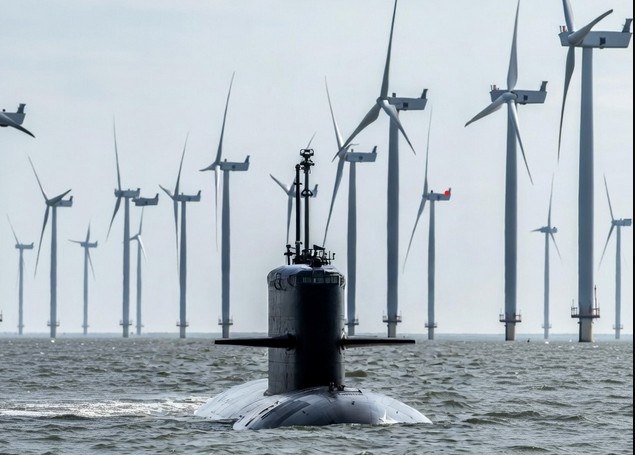
Research into the negative impact offshore wind turbines have on military radar and sonar indicate that foreign adversaries could exploit points of vulnerability those projects create along America’s East Coast.
But for the fifth time in in a period of a few weeks a federal judge has ruled that the offshore wind projects the Trump administration blocked citing national security concerns can be reactivated. In December, the Interior Department announced that it would halt leases for the projects so the Department of War could work with the lease holders to mitigate national security concerns. But in the latest ruling enabling the Sunrise Wind project to resume off the coast of New York state’s Long Island, Judge Royce Lamberth said the administration’s concerns over national security were too ambiguous and insufficient to justify pausing construction.
Judge Chooses Environmentalists Over the Navy
“Every court to review this question has now found that the loss of specialized vessels and resulting delays amounts to irreparable harm,” U.S. District Court Judge Royce Lamberth said as he ruled in favor of allowing Denmark-owned Orsted permission to resume the project. “I agree,” the judge added.
Trump’s Interior Department has ample time to appeal the rulings, and it should for all the reasons I highlight and discuss in my new book, Climate Porn: How and Why Anti-Population Zealots Fabricate Science, while Targeting American Capitalism, Freedom, and Independence. The fact that some of the information describing how offshore wind turbines affect Navy sonar and radar is classified complicates the legal terrain. Even so, ample unclassified material has made the case to justify hitting the pause button on offshore wind. As I discuss in Climate Porn, there’s a long history of hostile foreign actors engaging in lawfare exercises that make use of America’s own climate and environmental initiatives. The dispute over offshore wind fits into a larger pattern of abusive litigation practices designed to benefit America’s strategic adversaries. President Trump and his administration should take the opportunity to inform the American people about the stakes if climate schemes tied in with foreign governments, especially the one in Beijing, become fully operational.
Early Warning Defense System in Jeopardy
The Interior Department’s Bureau of Ocean Energy Management (BOEM) released a report in 2020 that explains how the presence of wind turbines would greatly compromise the ability of key military installations along the East Coast to make effective use of their radars. The impact on the Air Route Surveillance Radar Version 4 (ARSR-4) located at Gibbsboro, New Jersey and Riverhead, New York are of particular concern. That’s because they are part of the North American Aerospace Defense Command (NORAD) early warning system. After examining the potential fallout from the Empire Wind Project off the coast of New York, BOEM determined that the Riverhead facility would encounter significant difficulties.
It found that smaller aircraft, which might include drones, would not be detected at lower heights above the turbines. In addition, the turbine operation would obscure the return signals from smaller craft at higher elevations, or from larger aircraft, creating numerous false targets.
A little further south, Naval Station Norfolk, in Virgina, faces similar pressures from offshore wind projects. Guy Higgins, a retired U.S. Navy captain with a background in aerospace technology and engineering, said in an interview he has significant concerns about what might transpire in and around Norfolk the largest naval base in the world. Norfolk serves as the headquarters of the U.S. Navy’s Fleet Forces Command. A battle has recently raged over the Biden-era funding of the Fairwinds Landing offshore wind facility off the coast of Norfolk.
Enemy Surveillance, Penetration Facilitated by Offshore Wind
Higgins envisions scenarios where interference from wind turbines could make it possible for drones and mini submarines to elude radar and penetrate American defenses.
“If I were China and wanted to attack a location with a wind farm, I’d use that wind farm as cover in same way Roy Rogers would take cover behind a boulder,” Higgins told me. “I would use wind farms as a cover for submarines because of increases in ambient sea noise. Also, from a radar perspective I would recognize those windfarms create all sorts of spurious contacts. I would tailor my drones to have a signature close to that coming off wind turbines and I could adjust it to be the same kind of speed, same type of altitude and same type of azimuth as those turbines.”
There are no real solutions to the standoff between policymakers who prioritize national security and the advocates of offshore wind that Higgins can see materializing. Instead, he sees only tradeoffs that may have to be settled at the presidential level.
“If I were going to take the side of the wind and renewable energy people in a place like Norfolk, I would say it’s inside the Chesapeake Bay and that it’s a protected environment and not terribly vulnerable to the issues we are talking about,” Higgins said. “But the Navy could easily come back and say we’ve got to be able to protect the naval base from intruders out in the Atlantic. Something could come into Norfolk just as a midget submarine did on Dec. 7, 1941, in Pearl Harbor. Small submarines don’t travel very far, but they could be brought in by a bigger submarine.”
China’s domination of our supply chains and the manufacturing that goes into renewable energy platforms also creates significant problems for the U.S. Chinese manufacturers have placed surveillance parts in wind and solar platforms—a massive security vulnerability aroundU.S. military bases.
“I would place a carpet ban on the use of any Chinese manufactured parts in sensitive U.S. equipment, whether it was defense or infrastructure or homeland security or the grid,” Higgins said. “I would just not be using any Chinese parts. I do not trust them.”
Climate Porn makes the case there is virtually no area of vital national security that is not touched by climate activism in some way. The deliberate, orchestrated effort to restrict America’s ability to project military and economic power, in a manner that benefits China and other top adversaries of the U.S., has captured the environmental movement as one of its most effective methods of penetrating our security vulnerabilities.
There is a lot more than meets the eye riding on the court rulings that put a temporary injunction against Trump’s efforts to halt offshore wind.
The Trump team has identified five projects that could affect national security: Vinyard Wind off Massachusetts, Revolution Wind off Rhode Island, Coastal Virginia Offshore Wind, Sunrise Wind off New York and Empire Wind off New York and New Jersey.
This article originally appeared at Restoration News