News and analysis from CFACT
CFACT billboards urge Wisconsin to stop making eco-mistakes.
Green New Deal, roving wolf packs, what could go wrong?
News and analysis from CFACT
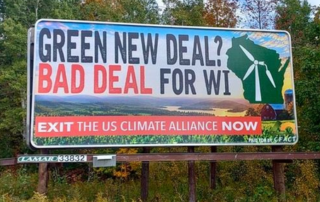
Green New Deal, roving wolf packs, what could go wrong?
Climate nonsense once again is hurting real people -- Texans may face power shortages this summer, and it is all the fault of Obama's war on coal. CFACT policy advisor Larry Bell notes that it would have been a lot worse had the Trump Administration and the courts not sidelined the jobs-killing Clean Power Plan.
CFACT Senior Policy Advisor Paul Driessen warns that the impending lawsuits against oil and gas companies -- created by corrupt city governments as a last-gasp hope for escaping bankruptcy -- pose grave danger for the U.S. economy should these cities succeed. Yet, says Driessen, the very premises of these suits suggests they should be thrown out of court.
CFACT Senior Policy Advisor Paul Driessen exposes the unscientific shenanigans of the International Agency for Research on Cancer that are under Congressional investigation for scientific bias, secrecy, and corruption -- and how the IARC, much of whose funding is from the U.S. Congress, has arrogantly obfuscated, stalled, and even demanded immunity.
Oil and natural gas aren’t just fuels. They supply building blocks for pharmaceuticals; plastics in vehicle bodies, athletic helmets, and numerous other products; and complex composites in solar panels and wind turbine blades and nacelles. The U.S. was importing 65% of its petroleum in 2005, creating serious national security concerns. But fracking helped cut imports to 40% and the U.S. now exports oil and gas. Today’s vital raw materials foundation also includes exotic minerals like gallium, germanium, rare-earth elements, and platinum-group metals. For the U.S., they are “critical” because they are required in thousands of applications; they become “strategic” when we don’t [...]
Data specialist Justhy Deva Prasad encourages the better use of available data -- with appropriate action the data call for -- by governments in particular to protect citizens from dangerous threats to their health and safety. He further shows how the failure to properly use data in disaster prevention strategies yielded bad results from Fukushima, Superstorm Sandy, ongoing California wildfires, andOroville Dam. And public officials should be held accountable for their failures.
CFACT Senior Policy Advisor Paul Driessen strongly recommends reading geologist Gregory Wrightstone's new 123-page book, "Inconvenient Facts: The Science That Al Gore Doesn't Want You To Know" as a tool for refuting the wild claims of climate alarmists and their minions.
By Dr. Tim Ball and Tom Harris Now that the excitement has died down over the news that Earth’s surface temperature made 2017 one of the hottest years on record, it is time for sober second thoughts. Did the January 18 announcement by the National Oceanic and Atmospheric Administration (NOAA) that 2017 was our planet’s third-hottest year since 1880, and NASA’s claim that it was the second hottest year, actually mean anything? Although the Los Angeles Times called 2017 “a top-three scorcher for planet Earth,” neither the NOAA nor the NASA records are significant. One would naturally expect the warmest years to come [...]
CFACT Senior Policy Analyst Paul Driessen sings an ode to the benefits of federalism and other gifts from the founders in an article inspired by a jazz combo. He reports that the 2016 election was swung in "flyover country" out of a growing frustration with an ever-expanding federal government that had largely discarded the concept of federalism and was dictating too many aspects of our lives.
As CFACT Senior Policy Analyst Paul Driessen explains, federal revenues from offshore drilling fell from $18 billion in 2008 to just $2.5 billion in 2016 thanks largely to Obama era policies while state revenues from closer-in rigs went up. The Trump-Zinke proposal would open federal waters (outside the 3-mile limit) to drilling, with huge potential revenues and contributions to national security. The planning and evaluation process, Driessen argues, should not be impeded.
Heartland Institute Senior Fellow (and CFACT advisor) H. Sterling Burnett, Ph.D., reviews the achievements of President Trump's energy and environmental policies at the end of his first year in office, a list he says indicates "a tremendous start" -- as evidenced by the stock market, job growth, unemployment decline, business investment, and consumer confidence -- all helping to "make America great again."
Five and one-half decades have now passed since a young President John F. Kennedy rallied a nation behind a bold challenge to send an American to the Moon and safely back before the end of that decade. We did this, and even better — putting four of our citizens on the lunar surface and returning them by 1969, plus delivered two more into lunar orbit who returned with them. Within three more years, eight others had walked on the Moon on successful round-trip voyages, along with four more orbital companions. An invitation to write an article about the Apollo legacy for [...]
While China, India, and other nations are building new coal-fired power plants, the United States, which nearly a quarter of the world's coal reserves, is still following the path laid out by President Obama of phasing out coal production. Canadian analyst Tom Harris, whose home province of Ontario has banned all coal-fired power generation, explains that this stems from the myth that carbon dioxide is as dirty as coal.
Blue State residents are turning blue from the cold that their solar heaters and wind turbines cannot rescue them from -- but Blue State politicians insist on blaming fossil fuels for making their residents cold (global warming actually means colder winters, right?). CFACT Senior Policy Advisor Paul Driessen points out the hypocrisies of the leftists who seek to win through censorship of factual information and opinions not in alignment with their fantasized story lines about climate and more.
CFACT policy advisor Larry Bell reports that the ongoing decrease in sunspot activity portends lower global temperatures -- demonstrating again that carbon dioxide is not the primary driver of climate change.