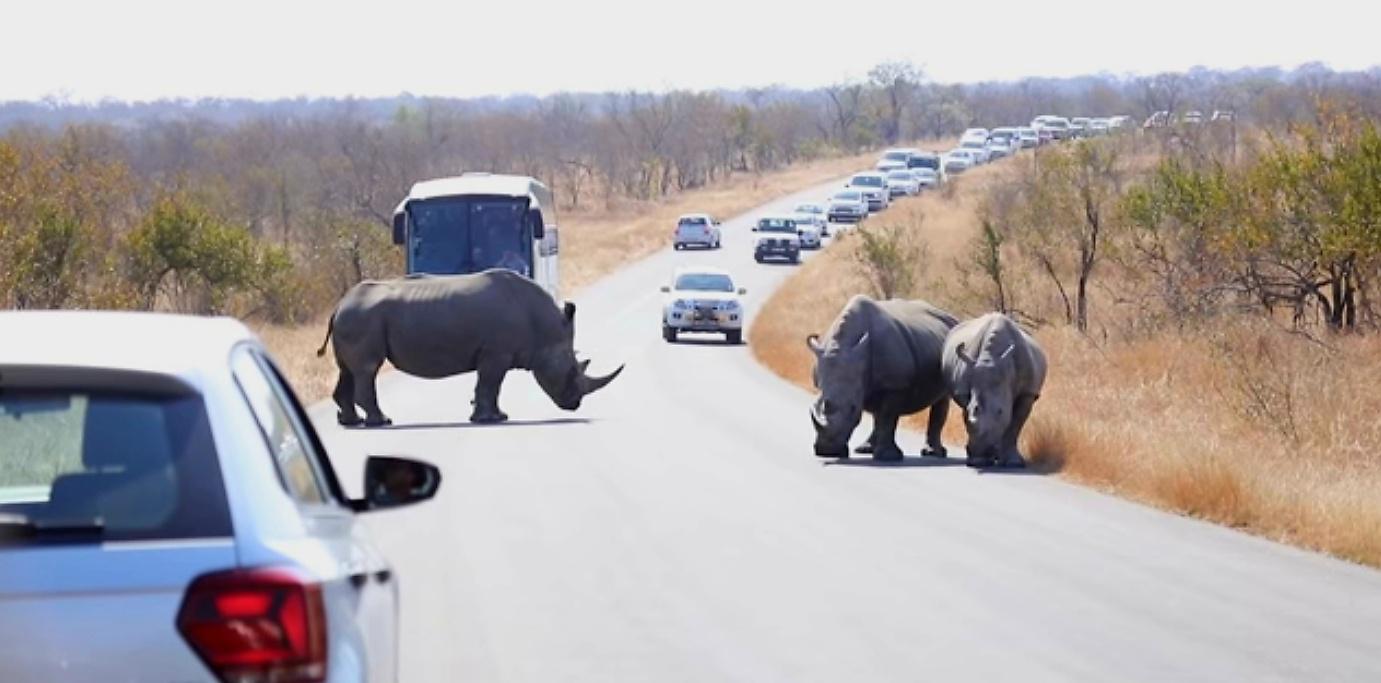
People from around the world flock to South Africa to see the wonderful scenery and the incredible wild animals in a genuine wild habitat. The yellow, dry grass of winter reveals scenes and animals that are not the same as in the green summer. Lions are that tan color because of the yellow grass. A lion is not behind a fence; it can walk right up to your car. It is amusing to South Africans to discover how many Americans do not seem to believe that there are vast areas with big game roaming wild.
You really can drive down a road and find that a giant elephant steps out of the bush in front of you. It is then quite likely that a few more will follow. So the locals know not to move until you’re sure that you will not find yourself bracketed by a group of powerful wild tuskers. What else may be in the nearby bush?
It is majestic and incredible to see elephants, rhinos, hippos, lions, and a host of other species walking around, as they have done for centuries.
People universally report the most amazing feeling deep in your soul after a few days in the wild bush. That environmental experience creeps into your bones and leaves an indelible mark deep inside you. Not only the visual, but also the cries of the night, and the calls of the dawn, are emotionally imprinted forever.
South Africa has diligently looked after this wild world heritage for centuries.
Horn and Tusk
But it is not only the tourists, poets, and philosophers who marvel at the wealth of the wild open spaces. Another interested category is…poachers. Rhino horn, kilo-for-kilo, sells for more than the price of gold.  Elephant ivory is in constant demand. Horn and tusk are virtually all traded illegally. Perversely, much of this is due to misplaced international moves to supposedly ‘save the animals.’ A totally predictable result is that usually, as soon as the legal trade is stopped, the illegal trade flourishes.
The illegal trade is brutal.
An indelible mental image is one of a rhino which has had its horn cut out of its face, with a chainsaw. The rhino was alive during the agonizing process. The poacher’s rifle shot brought it down but did not kill it. The poachers have to move fast to avoid arrest, so the chainsaw was used on the terrified rhino.
Then, Greenpeace and their ilk demand that South Africa stop using coal-fired power stations ‘to save the planet.’ So, South African folks say, “Hey, what about the elephants and rhinos?” The greens answer, ‘Stop using fossil fuels,’ and they demand more carbon taxes on aeroplane flights. Greens are always in need of cash. They get it from donations, which are frequently more like blackmail. I have had personal experience of big corporations who were approached by green organizations and ‘requested’ to make a major donation…or else the company is going to get hammered in the media.
Across the seas
So, where do rhino horns and elephant tusks go?
Well, typically, they are smuggled out of South Africa on underground routes. The path is into Mozambique, via middlemen, and onto ships bound for China and parts of the Far East.
Where are the green organizations? Are they attempting to stop the smuggling routes and hunting down the smuggling ships? No, they are marching against nuclear power and stopping gas fracking.
So, who fights the poachers? Well, it is local South African teams who do a wonderful job. But it is a tough  task when the poachers have AK-47’s and use helicopters…and carry chainsaws.
The reality is that the international penalties for using electricity produced from coal are far greater than those for shooting and cutting up elephants and rhinos.
Is this right?
Why do the large Western-world countries seem to care far more for their own political-environmental interests, than for the genuine efforts of countries like South Africa in trying to safeguard rhinos, elephants, and an array of wildlife?
Money and Power
The environment, in all its marvelous forms, should be safeguarded. But it needs to be done with genuine intelligence and with honesty. Trying to cut back on international air travel while the poachers’ guns roar and the chainsaws scream, really is not the best way to safeguard the planet.
The so-called environmental actions that are seen all over the world are frequently nothing more than the efforts of some groups of people to make money and gain political power.
An investigation of the websites and writings of many of the well-known green groups shows clearly that they are aiming to introduce world socialism. Many of their protest-march placards openly state ‘change the system’ and similar.
To really safeguard areas of the planet needs intelligence and honesty. Sadly, these qualities are frequently lacking.
Swindling and distorting environmental data in messages for the political and financial gain of a few green groups is the height of hypocrisy.
Pictures by Dr. Kelvin Kemm