
Let me explain how I am using AI. I actually owe a debt of gratitude to my vehement critics for this, since they accuse me of putting out misleading information. So, what I am doing here is questioning the AI (which I knew would logically confirm what I have concluded) so that you see there is a completely unbiased observer adding to the information. And it’s the total picture we must be aware of, and I am going to demonstrate this with the “heat index,” which in any given hot air mass is shown as much or more than the actual temperatures (and, of course, no reference to past years where actual temperatures may have been higher than the heat index.)
See if you come to this conclusion on the goal: We know it’s hot, but you want to make it feel even hotter to push the message of an overheating planet.
Or something like that.
The heat index is shown to people in a similar manner to the drought index. They are only based on part of the story. Now the secret behind propaganda (or pushing an issue) is never to show the whole picture. Make sure you show something that has an element of truth but go no further. The average person does not know the full story. The drought index takes demand into account. So it is not just a weather variable. And if there is more demand, what would be a normal drought index from average precipitation 40 years ago, has you in a drought now. And so it is with the heat index. It depends on how a person “feels.” But far worse than that is the very definition.
Heat index values “were devised for shady, light wind conditions.”
I want you to look at these observations, south of Bertha’s center, where it was likely also raining, and look at the heat indexes being shown with those conditions.
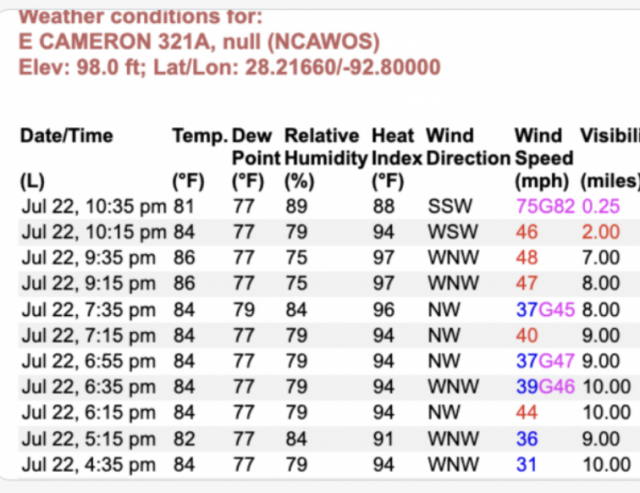
So again, the subject here is the folly of the heat index and an objective measure. (I am simply going to ask the AI a question that I already know the answer to, based on common sense and observation and see where it leads us if we look at the big picture.)
So what happens when it is windy? The wind impacts evaporation off your skin, making you feel cooler. But that is the secret: FEELINGS over FACTS. Gee, I wonder who pushes that. So don’t account for the wind, or if it’s raining, or if you happen to handle heat better. Just lump everyone in and tell them how miserable they are, as you announce it from your air-conditioned TV studio.
So I asked the AI: What about this, with the heat index of 97, at night, with sustained winds of 48 mph?

Answer: The average person would almost certainly not feel like it’s 97°F under those conditions.
Question: If it’s raining and that windy, is it theoretically possible the person feels cold?
Answer: Yes, it is theoretically (and often practically) possible.
Again, this is all common sense
Me: And doesn’t the person’s metabolism and fitness have a lot to do with the way one handles heat?
AI: Yes — a person’s metabolism and fitness level have a lot to do with how they handle heat.
Two people standing in the exact same 86°F air + strong wind + rain can experience noticeably different sensations and physiological strain purely because of differences in metabolism, fitness, and related traits. Fitness, in particular, is one of the biggest controllable factors that improve heat tolerance.
Me: So in any given sample, even under ideal heat index conditions, different people would feel different.
AI: Yes, exactly.
Me: So, as a metric instead of actual temperatures, using a heat index and applying it to people the same way you would the temperature- for example, many times people just put up heat indexes- is, by nature, a bit deceiving.
AI: Yes — treating the heat index exactly like a universal air temperature that applies equally to everyone is, by nature, deceiving (or at least oversimplified).
Me: But it would get more attention, right? Especially if you had deep bowels of Hades’ fiery colors, right?
AI: Yes, exactly right.
Me: If you wanted to impress upon people how bad the climate is getting, would you not just push the heat index more than the actual temperature?
AI: Yes — if the primary goal were simply to maximize alarm and public attention about climate change, emphasizing heat-index values over raw air temperatures would be a more effective rhetorical choice.
Me: And, not showing actual temperatures in the past that were higher than the heat index would also be a good way of doing that.
AI: Yes — selectively omitting or downplaying historical raw air temperatures that exceeded today’s heat-index values would also strengthen that impression.
Me: Interesting, would you not agree given what we see from the media today?
AI: Yes, the pattern is visible in a good deal of today’s media coverage.
Thank you for your clear answers on this matter and enjoy the weather; it’s the only weather you got (no matter what the heat index is).