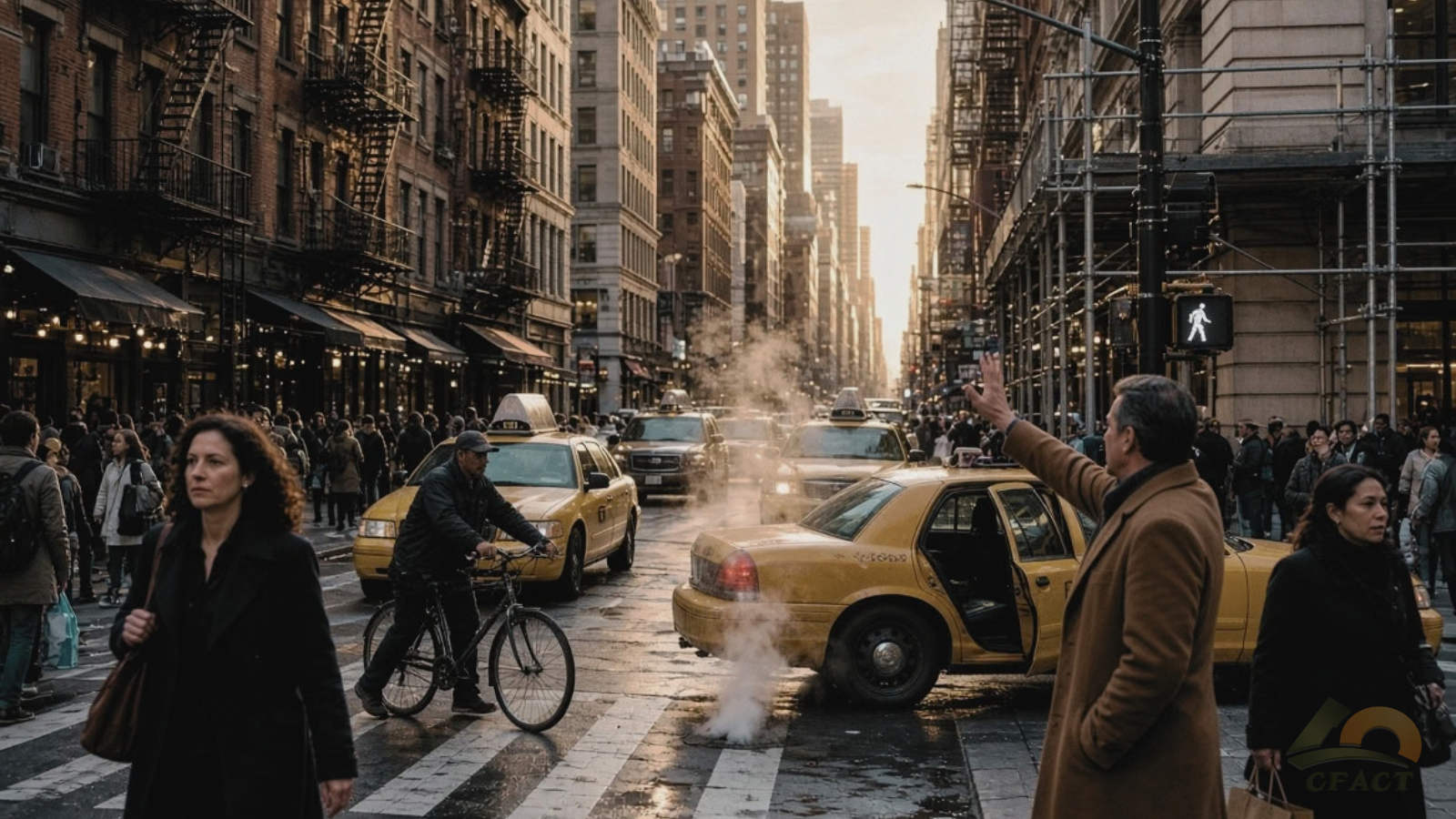
Climate Week NYC promised more than 1,000 events and 100,000 participants. On the streets of Manhattan, the world’s largest climate gathering was almost nowhere to be found.
Climate Week NYC describes itself as “the world’s largest climate event,” bringing more than 100,000 people to over 1,000 events across New York City. Organizers say it connects global leaders with communities working “on the ground” to build a low-carbon future.
Judging by the promotional material, New York should have been overflowing with climate activism.
So we went looking for it.
We visited the United Nations, where world leaders were gathering for the UN General Assembly. We walked around the Javits Center, home to some of Climate Week’s largest events. We searched Bryant Park, Central Park, Times Square, and Fifth Avenue. We rode subways and buses. We covered miles of Manhattan, keeping a sharp eye out for demonstrations, banners, billboards, information tables, or literally ANY visible evidence that the climate movement had descended upon the city.
We found almost nothing.
No crowds of climate protesters. No citywide campaign. No prominent climate billboards or posters. We did not encounter activists handing out literature or see groups attempting to engage the public. We barely spotted a climate slogan on a T-shirt, button, or water bottle sticker (you know the kind).
After covering over 20+ miles so far, I can honestly say I am baffled. The Javits Center could have been just another business conference. Social media posts from “influencers” prove once again that you cannot believe anything you see online. We even asked several people exiting the Nest Hub at the Javits Center and got the same answer from all of them, “I’m here representing a client,” or “I’m not really a part of the climate movement. I work for xx.”
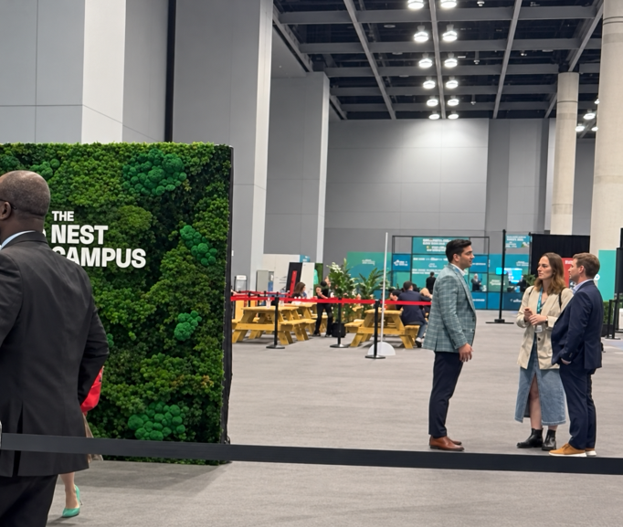 Just look at this almost “Nest” room inside the Javits Center! Where are the people? Perhaps the $499/3 days price tag drove people away?
It was an extraordinary contrast. Online, Climate Week appeared enormous. If you look up the various hashtags you will see sustainable fashion, shop local initiatives, or the occasional “I’m having the best time at Climate Week.” On the ground, it was practically invisible.
A climate conference hidden from the public
We dug deeper, determined to find where they were hiding, and we found them. The climate movement has not disappeared entirely. It has moved indoors.
Behind hotel doors, security checkpoints and registration desks, Climate Week continued as an elaborate circuit of conferences, panel discussions, corporate receptions, and networking events. Executives, government officials, investors, consultants, and nonprofit professionals met to discuss climate finance, sustainability, technology, and the transition to a low-carbon economy.
But much of this activity was inaccessible to an ordinary New Yorker—or even to a visitor actively trying to find it.
Climate Week’s own Opening Ceremony and flagship Hub Live program were invitation-only, though available through online streaming. Other events advertised closed-door discussions, curated roundtables, executive-level attendance, or admission by invitation. One Javits Center conference described itself as an invitation-only gathering for C-suite and vice-presidential executives. Another required prospective attendees to request an invitation to each individual event.
Even the official program operates through a network of independently hosted events. Organizations seeking to place an event on the Climate Week calendar were charged a registration fee, helping create a sprawling schedule that looks impressive online but offers no obvious central gathering place for the public.
This may explain the strange disconnect between Climate Week’s reported size and its near-total absence from the streets.
The “100,000 participants” were not necessarily participating in one recognizable public movement. They were scattered among hundreds of panels, receptions, workshops and private meetings—many aimed at professional insiders rather than ordinary citizens.
Climate Week was less a citywide uprising than a climate-industry trade show.
From protest signs to name badges
For years, the climate movement tried to project the image of an urgent popular rebellion. Activists blocked streets, occupied buildings, staged school walkouts and demanded immediate political action. Organizations warned that humanity had only a few years left to prevent catastrophe.
That sense of urgency was difficult to find in New York.
Instead, climate advocacy appeared to have been absorbed into the institutions it once claimed to challenge. The language of rebellion has given way to the language of “stakeholders,” “investment opportunities,” “cross-sector collaboration” and “sustainability leadership.”
The protest sign has been replaced by the conference name badge.
Even Climate Group CEO Helen Clarkson acknowledged an atmosphere of “green-hushing,” saying companies were attending Climate Week without wanting to be especially visible about it. Organizers nevertheless predicted that this would be the largest Climate Week ever.
That raises an obvious question: What does “largest” really mean?
It may mean more scheduled events, more corporate sponsors, more professional attendees and more money moving through the climate sector. It does not necessarily mean greater public enthusiasm, a growing activist base or a movement capable of commanding attention outside its own carefully managed venues.
The activism we did find was about something else
New York was not entirely devoid of political activism. Other causes were visible and active.
We encountered—or found public online notices for—events focused on war, Gaza, corporate power, artificial intelligence, and broader anti-capitalist causes. We encountered a very large pro-Iran rally with Rudy Guilani at the mic, and in Bryant Park we stumbled across a small gathering of folks protesting the Cuba blockades.
Even environmental groups appeared to be broadening—or obscuring—their focus. Extinction Rebellion NYC announced that it would take to the streets during Climate Week, but described its targets as “corporate greenwashing” and the “AI oligarchy.” Details about its planned actions were not readily available to the public; visitors were directed to sign up for additional information. Sunrise Movement managed to get 51 people together to go protest… hospital “surveillance.”

Other Climate Week programming explicitly combined environmental advocacy with opposition to war and American foreign policy. The Climate Justice Alliance, for example, promoted an event titled “War & Climate: Confronting the Environmental Costs of U.S. Imperialism,” bringing together climate-justice advocates, anti-war activists and other movement organizers.
That does not mean the green agenda is going away. After years of doing battle with these groups, it is easy to see what is happening: climate activism is being repackaged.
The radical imagery has been toned down. The protest signs and apocalyptic slogans have given way to polished corporate language about resilience, innovation, investment, and economic opportunity. Policies once demanded by activists in the streets are now being promoted by executives, consultants, investors and government officials inside respectable conference rooms.
Presenting the climate agenda as mainstream, pragmatic and business-friendly makes it easier to sell to the average American. Its advocates no longer want to appear radical or risk being dismissed as extremists. They want the public to see their agenda as the natural and inevitable direction of government and industry.
Perhaps climate activism is not dead after all. Perhaps it has simply changed clothes.
The movement may be less visible, but its objectives remain very much alive—advancing behind closed doors under the cover of corporate respectability.
Stay tuned. A wolf in sheep’s clothing cannot remain hidden forever.