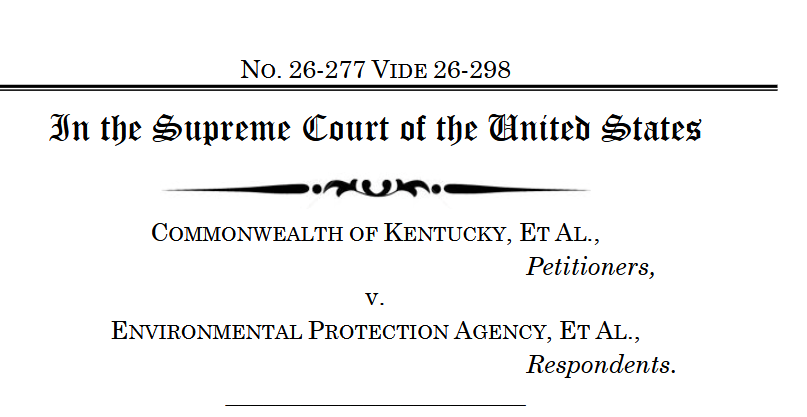
The Committee for a Constructive Tomorrow (CFACT) has joined the Competitive Enterprise Institute, the Energy & Environment Legal Institute, the Heartland Institute, and Heartland Impact in an amicus brief asking the U.S. Supreme Court to review EPA’s 2024 fine particulate matter (PM2.5) standard.
The brief, filed October 2 in Kentucky v. EPA and Chamber of Commerce v. EPA, supports state and business petitioners challenging the rule. The rule cut the annual PM2.5 clean air standard by 25 percent, from 12 to 9 micrograms per cubic meter. EPA itself later acknowledged that this was the first time in the Clean Air Act’s history that a national air standard was revised without the “thorough review” Congress requires. The D.C. Circuit nonetheless upheld the rule in June.
The coalition argues that Congress never clearly authorized EPA to skip that scientific review. Under the major questions doctrine, the brief says, a power of this economic and political significance requires clear authorization. The National Association of Manufacturers estimates the standard threatens 474 manufacturing projects, nearly $1 trillion in investment, and more than 122,000 jobs.
The groups also question whether the tighter standard is needed to protect health at all. EPA’s case rests largely on statistical associations in population studies, not demonstrated cause and effect, and analysts at CEI and JunkScience.com’s Steve Milloy have long pointed out that EPA’s own clinical experiments exposed volunteers to PM2.5 at levels many times the standard without reports of deaths or serious harm. With America’s air already among the cleanest in the world and fine-particle levels falling for decades, CFACT and its allies argue the new standard delivers enormous costs for little if any measurable health benefit.
“EPA dismissed its own independent science advisors, skipped the full scientific review Congress requires, and then imposed a standard that puts nearly a trillion dollars in American investment at risk,” said CFACT President Craig Rucker. “Congress built that review process so that national standards rest on sound science, not political preference. We’re proud to stand with our allies in asking the Supreme Court to hold EPA to the law.”
The brief was filed by Ondray T. Harris of the Competitive Enterprise Institute, counsel of record.