Every hurricane season, three issues come up with me, not necessarily in order of importance. One of them was evident a couple of weeks ago with the nor’easter that developed an eye. Its formation over abnormally warm water near or above the threshold for tropical cyclones fueled the debate, along with objective evidence that it had become a warm-core system. I reviewed that in a previous blog.
Another is a complete overhaul of the Saffir-Simpson scale. The Weatherbell Power Impact Scale accounts for storm size by assigning values to the radius of hurricane-force winds, 50-knot winds, and 34-knot winds. It also considers sea-level pressure, maximum wind, and maximum wind gust. So it’s quite comprehensive—not just one value. At the very least, it should grade the Saffir-Simpson scale in tenths. A category two storm at 110 miles per hour becomes category three at 111. It should be labeled as a 2.9, as opposed to, say, a 95-mile-per-hour storm, which would be lower.
By the way, Bill O Reilly gave me this idea the night Ike was on the way to hit Texas. It had been lowered to a 2, and he remarked off air that it meant it should not be as bad. As an example of what my scale would give, because SIZE MATTERS
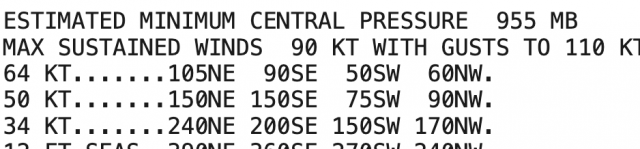

The max wind we classify off the Saffir-Simpson scale is 2.8. Wind gusts ge 3.8.
SLP gets 3.3
The hurricane-force winds get a rating of 3.2
50 kt wind is also at 3.2
34kt force winds: 3.7
This gives a total of 20
Divided by 6 makes it a 3.7 at landfall
The explanation as to parameter computation is on the Weatherbell.com site
A spot wind at one place does not do justice to the storm. Conversely, some smaller storms may have the same Saffir-Simpson rating but not be in the same ballpark, except where the center crosses the coast. Charley, a Cat 4, vs. Donna, also a Cat 4 when it hit the same place in Florida, is a classic example. We want to look at the storm as a whole, not just one spot.
But what I really want to talk about here is something I’ve been trying to push for many years, and that is to seed intensifying hurricanes as they’re coming to the coast in the last 12-24 hours before landfall. There was a seeding project many years ago—Project Stormfury—and the results were inconclusive, although some were pretty impressive, especially with Hurricane Debbie in 1969. I remember as a kid being upset that they were going to seed the storm because I wanted it to intensify. But it was out in the middle of nowhere.
The idea is that if you can disrupt the storm’s eye wall and focus energy away from the center, you can reduce wind intensity at the center. This is not dropping atomic bombs into the eye wall. It’s trying to force condensation in a way that spreads out the hurricane’s concentrated energy. We see practical examples of this where you have a strong hurricane that will hit land: the eyewall will fall apart; it will then get back out over the water, but it takes a long time to get back to where it was, and in most cases it never gets back to where it was. You should examine anything you can do to disrupt the processes that are causing the storm to intensify.
Now, there are people who will say, “Well, there’s no real proof this will do anything.” So what? Can you not try it? What do you have to lose if you have a Category 4 hurricane and could knock it down to a Category 3 in terms of max wind? You can help mitigate the cost. Sometimes I think that there are people who are simply anti-progress in this country that don’t want to see this. Some people also think you shouldn’t mess with nature at all, and of course they go off the deep end with the whole chemtrail argument. But the fact is, with something so disruptive as this, why would you not want to give it a shot of knocking it down? It’s like the whole nuclear power argument. People fear something going wrong. Not only did Jane Fonda protest the war, but her movie The China Syndrome also set the stage for an almost irrational resistance to moving forward with nuclear power. It’s one of the most interesting things about the so-called progressive movement—in many things it’s the opposite. But again, what do you have to lose?
If you have a hurricane and can induce eyewall replacement—which we know can stop the storm from intensifying, if not briefly bring it down—why wouldn’t you try it? We live in the United States. It’s the year 2026. Why should we live like it was 75 years ago, afraid of something when we could mitigate it? It almost seems like some people don’t want to stop hurricanes from being destructive when they hit the United States. Pardon my skepticism or cynicism, but I think some people want to see the worst happen so they can make a point about things getting worse climate-wise. And then there’s the other part that just loves it when these storms wrap up and go wild.
I believe someday all 3 of these ideas will be addressed, if not to my suggestion, then in some way that resembles the ideas put forth. But until such a time, the status quo remains. Interesting, since what got you to a place is also what can get you stuck there if there is no change.