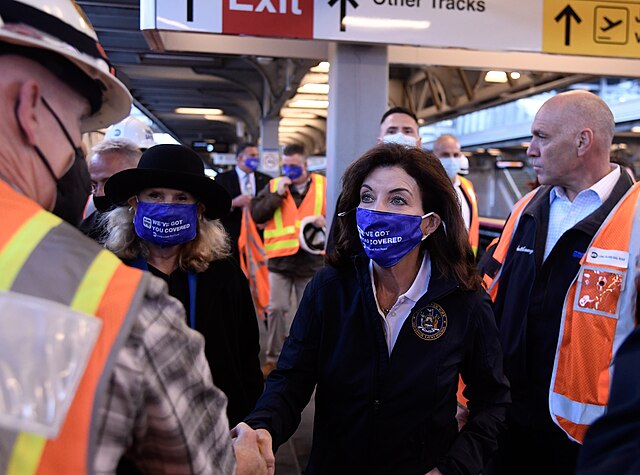
After warning of the Climate Act’s unlivable costs, Governor Hochul has now proposed specific legislative actions to begin to back away from them. I consider this a potential victory, but it remains to be seen what the legislature actually does.
At least the big green wheel is in spin. That is progress in itself. The show is on in New York State.
Hochul’s proposals are carefully crafted to do the job with a minimum of political fuss. The basic law is unchanged, but the target dates are slipped well into the political future.
Moreover, the changes are made as a small part of the annual big budget bill, not as a separate legislative action. This minimizes the nasty public debate that would accompany a stand-alone amendment to the Climate Act.
There are two simple changes that must be made plus a not so simple one that would be very useful.
The first simple change is that the near-term targets are shifted from 2030 to 2040, which is well over the political horizon. The 2030 target is impossible, but 2040 is still open to fact-free speculation, which is all that politics requires.
The second simple change is the crucial one that the first change makes room for. The draconian regulatory requirement is slipped until 2030.
Unlike other states’ toothless climate laws, the New York law has a provision calling for regulations that “ensure” compliance with the Act’s impossible targets. It was these required regulations that caused the present turmoil.
The regs were required by around 2024 but were never put out because the cost was politically prohibitive. Several green groups sued and, last year, the judge ruled correctly that the law is the law, so the Hochul administration cannot decline to issue the nutty rules.
The judge gave New York a few months to change the Climate Act to eliminate the regulation requirement. This was appealed, giving the legislature more time, which is where we are today. The Act is clear, so the appeal is unlikely to succeed. The regulatory clock is ticking.
Pushing the regulations into the future solves the problem for now which is all that matters politically. This is the heart of Hochul’s proposal.
The third proposed change is actually hilarious, because almost no one will understand it, so it will be fun to watch them try. It is truly arcane climate science. The issue is how to calculate the global warming potential of methane. Only people who are deeply into alarmist science will understand this issue. I used to, but it has been years, so I no longer understand it in technical detail.
The gist is that the IPCC and most states that care about methane emissions use a 100-year timeframe while the Climate Act uses 25 years. This shorter time apparently pumps up the adverse impact of methane emissions. I have been told that it does so, to the point that if New York switched their methane accounting to 100 years, they would be close to meeting the 2030 target.
In her proposal, Hochul merely mentions an issue with 25 versus 100 years, without saying what those numbers refer to. I imagine readers scratching their heads over this, wondering if perhaps it is about target dates or something.
The methane science itself is well beyond most people’s comprehension, especially New York legislators. The confusion could be very entertaining.
Politics is the art of compromise, and this 3-part proposal fits that bill. Hochul has walked the fine line between alarmism and reality with grace and skill.
How this works out now remains to be seen. If the budget bill tactic works, it could happen pretty quickly. Hochul has taken the political high ground of “affordability,” and a lot of Democrat legislators are massing on that rhetorical hill as well. It just might work.
I consider this push to back off the Climate Act to be a victory for skepticism. That the Act is extremely not affordable is the central message. I even have a research report on its impossibility here.
Stay tuned to CFACT to see how this drama plays out.
Image NY MTA creative commons