Trump’s race to launch nuclear microreactors changes everything
An Australian led team built one in just 150 days.

An Australian led team built one in just 150 days.

The inflow of money to fusion companies affirms that the strategy has broad support.
You need real-world evidence to show whether the fantasy speculation is true or false.
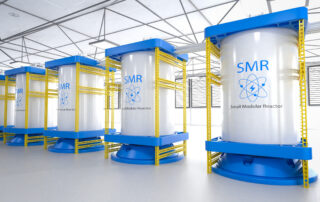
Small modular reactors are available now and offer a very constructive way to meet our energy needs.

If all goes well, LIS will have fuel ready by the time new reactors are cleared to operate.

There are more than 90 designs for small modular nuclear reactors.
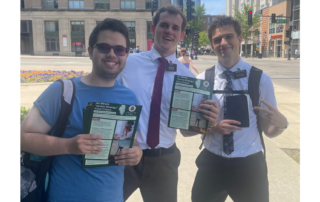
As students passed through the University of Illinois Urbana-Champaign quad during finals week, they were met with a different perspective on climate change.

"Nuclear energy holds the potential to accelerate African progress, strengthen essential services, and promote inclusive development across all communities."

The recent international political upheavals have vividly shown the importance of energy security.

From Georgia to Michigan, CFACT collegians are urging federal regulators not to smother America’s next great energy breakthrough in red tape. As the United States Nuclear Regulatory Commission considers its regulatory framework for fusion energy systems, three CFACT students submitted public comments calling for a clear, streamlined approach that recognizes fusion’s unique safety profile and enormous potential for American energy dominance. Bryce McConnell of Kennesaw State University, Tal Prottas of Bentley University, and Jasper Gugino of Grand Valley State University each made the case that fusion should not be forced into outdated regulatory models designed for fission, but instead allowed to [...]

The energy times they are a-changin'.
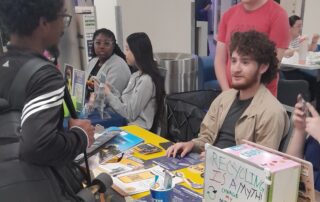
CFACT collegians brought direct, open debate to campus walkways at Florida International University and Clemson University through a series of “Change My Mind” tabling events—engaging students in substantive conversations on energy, conservation, and environmental policy. At Florida International University in Miami, campus representative Joshua Espinoza set up his table inside the Graham Center, a high-traffic student hub, and rotated between two thought-provoking discussion prompts: “Recycling is a Myth” and “Nuclear is the Future.” Espinoza (featured in bottom panels below, center & right) was joined by a team of fellow like-minded students who helped staff the table, distribute materials, and engage passersby—expanding [...]
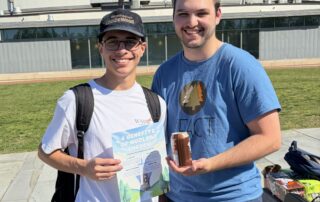
Under bright spring skies filled with aircraft taking off from the school-operated airport, and with a steady flow of prospective students visiting campus, CFACT Collegians at Liberty University turned a routine orientation day into a hands-on lesson in energy reality. On April 10th, campus representatives Silas Pearson and Colton Smith—joined by National Director Nate Myers fresh off CFACT’s ICCC16 conference in Washington, D.C.—hosted a dual event combining a nuclear soda giveaway with an interactive “Power the Grid” beanbag toss. The setup was simple, but the impact was anything but. Silas engaged students at the table, handing out sodas alongside flyers highlighting [...]

Reducing review times from decades to 18 months or less, will make President Trump’s goal of revitalizing the U.S. nuclear energy industry more competitive – “to everyone’s benefit.”
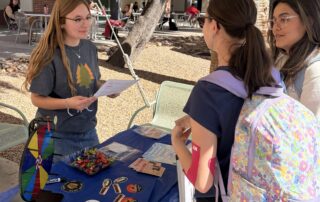
CFACT Collegians are proving once again that meaningful conversations about energy don’t have to happen in lecture halls—they can start with something as simple as a spin of the wheel and a piece of candy. At the University of Arizona, campus representative Ashlee Mendola (pictured above) brought nuclear energy education straight to the heart of campus life. Setting up on the busy mall near the student union, Ashlee invited passing students to test their knowledge with a colorful prize wheel featuring nuclear energy trivia. The concept was simple: answer a question, win some candy—but the impact ran much deeper. Ashlee reported [...]