Oregon ballot initiative would end animal agriculture, hunting, fishing
The Oregon Initiative Petition 13 (IP 13), known as the Abuse, Neglect, and Assault Exemption Modification and Improvement Act.

The Oregon Initiative Petition 13 (IP 13), known as the Abuse, Neglect, and Assault Exemption Modification and Improvement Act.
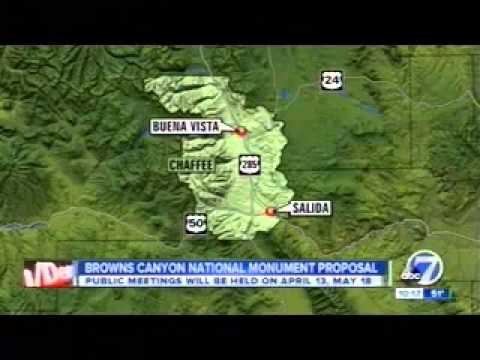
Once again, a President has designated land for national monuments without the advice and consent of Congress -- an action unchecked during the Bush years after President Clinton's highly controversial designation of the Grand Staircase Escalante National Monument in Utah. These land grabs may sound noble, but whenever federal officials replace state and local land managers, they tend to create problems for continuing use of the land and even surrounding areas. This is particularly true of Brown's Canyon in Colorado, says the Colorado Cattlemen's Association.
OPEC's Secretary General Abdulla al-Badri last month predicted oil prices will rebound to as much as $200 per barrel, a figure CFACT advisor Marita Noon suggests could only come about if terrorism and internal strife force shutdowns of major oil-producing states such as al-Badri's native Libya and other Middle Eastern nations vulnerable to radical assaults. Otherwise, Noon notes, as soon as the price jumps about $70 per barrel, the nimble U.S. wildcatters will step up their production again and hold the oil price well below al-Badri's predicted $200 per barrel.
Long before Obama, the federal government had been conducting a war against farmers and ranchers in the West. Every new action under the Endangered Species Act, every land grab (aka National Monument designation), every effort to introduce predators into lands used for decades, even centuries, to support human activity, is an assault by rich and powerful bullies who despise the simple lifestyle these hard-working people lead. But who will stop this war against the American West?
Marita Noon explains how the Center for Biological Diversity, a group founded by fired federal employees, has misused the Endangered Species Act to stop development and pocket millions of dollars - and the compliant federal government is not even keeping track of tyhe money it has doled out in legal fees who file friendly lawsuits that are quickly settled to the detriment of citizens.
The bald eagle, a bird which serves as our nation’s symbol, has long enjoyed special protection under the Migratory Bird Treaty and Bald Eagle Protection Act. These permits, unlike previous ones, will allow for the killing of eagles for a lengthy 30 years.

While many see wind power as a renewable source of earth- friendly energy, increasing numbers of conservationists are taking a dimmer view of them because of their impact on wildlife – particularly bats.
That electricity can be produced from sunshine, wind, and coal is news to no one. But how about jellyfish?
If you travel to the Everglade National Park in Florida, beware of vandals ready to rip door seals and windshield wipers off your car when you’re not looking. What kind of vandals would do such a thing? How about flying vultures!
Eradicating rats from a building can often be difficult. But how about eliminating them from an entire island?
The pygmy rabbit, whose size is not much bigger than a man’s hand, was thought to be nearing extinction in Washington’s Columbia basin in 2003. Since that time, wildlife officials have undertaken to save the furry critter and today some 20 of them are, so to speak, back in their native holes.
As Western states continue to develop their oil and gas resources, environmentalists are increasingly concerned about how such activity will impact prairie chickens. Fortunately, local farmers, industry officials, and environmentalists have been working together and are now pitching a free-market solution . . .
It’s important to remember that virtually all of the domestic plant foods the world depends upon for survival are products of deliberate genetic alteration. Included are hardier grains, larger fruits, and pest-resistant vegetables enjoyed everywhere. For example, about 90% of wheat now grown in the world called “hexaploid” is not a naturally occurring variety. Rather, it is the result of selective cross-breeding of many varieties developed over the millennia. In early times wheat cultivated in the Levant around 10000 B.C. was merged with a grass (“Aegilops tauschii,” or “goatgrass”) developed near the Caspian Sea around 2000 B.C., ultimately leading what we now refer to as “bread wheat.”
The Great White Shark is a renowned ocean predator thanks to the movie “Jaws.” But in recent decades, a West-Coast cousin of this fearsome animal has declined in number to the point that conservation officials have been considering placing it on the Endangered Species List. Now comes a new study by NOAA allaying these fears.
You’ve probably heard about reintroducing wolves and bears into the wild, but how about insects? Well believe it or not, Scotland’s Royal Society for the Protection of Birds is advocating a reintroduction of insects, and it’s creating, dare we say, quite a buzz.