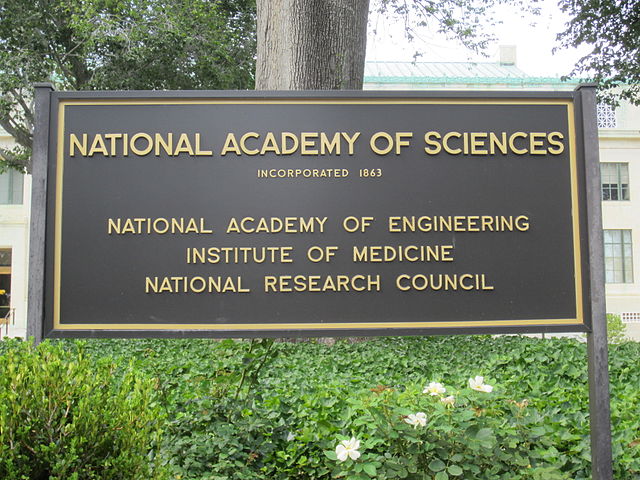
I recently had the honor of submitting CFACT’s comments on the National Academy of Sciences’ so-called “fast-track study” on whether the CO2 increase is dangerous. Our point is simply that there is a lot of debate.
National Academy of Sciences (NAS) has a dilemma here. Their study is a rapid response to the recent DOE study finding that the CO2 increase is not dangerous, which supports EPA’s proposal to repeal the old CO2 endangerment finding.
NAS is a leading alarmist, so of course they disagree. But it is a basic tenant of alarmism that there is no serious debate. Explicitly responding to the DOE report makes it clear that there is a deep debate. But if they do not respond, they let the DOE report stand. It will be fun to see how they handle this.
Note that the comments are addressed to the NASEM, which is the National Academies of Sciences, Engineering, and Medicine, because NAS no longer acts alone. Given this is a science issue, the play is in NAS’s court. Also, DOE is the world’s largest funder of physics research, so this is truly a debate among titans. Stay tuned to CFACT as this game plays.
Here are the comments:
CFACT comments on NASEM fast-track study
I am David Wojick, Ph.d., Senior Advisor and Analyst at CFACT (https://www.cfact.org). This is a CFACT submission. My research field is decision making under uncertainty especially the logic and structure of complex issues. I have maintained a running issue analysis of the climate change debate since 1992. Our comments follow.
The fast-track study needs to carefully address disagreements
1. CO2 Sensitivity
The fast-track study description makes reference to disagreements, so it needs to thoroughly address what is likely the greatest of the many disagreements that characterize the scientific debate. The issue is what is known simply as CO2 climate sensitivity.
I am sure the study committee is familiar with this concept. Roughly speaking, it is the amount of warming projected to occur if the atmospheric concentration of CO2 is doubled, all other things being equal. Note that this is not a prediction as numerous other things are likely to occur in reality. For example: changes in cloud cover, in ocean circulation, or in long term chaotic parameter oscillations.
Even so, CO2 sensitivity is a central measure when it comes to the question of whether a CO2 increase might be harmful. There are several levels of deep disagreement over the magnitude of CO2 sensitivity. The first level is within the collection of climate models. These present a wide range of values, from just under two degrees C to well over five degrees. This great range is sufficient to show that no model can be taken to be likely to be correct. As a corollary, it follows that no extreme event CO2 attribution study based on one model can be considered correct.
The degree of disagreement increases when one considers the observation based estimates of CO2 sensitivity. These mostly range from as little as 1.0 degrees C to 2.5 degrees, with none supporting the higher model values. This is especially important given that the hotter models are the primary evidence that increasing CO2 might be harmful. Disagreement is a powerful form of uncertainty.
The lack of evidence due to uncertainty gets even greater when one adds in the various arguments that the CO2 increase has not caused a significant fraction of the observed warming or that the CO2 increase is not driven solely by our emissions. These arguments also need to be addressed.
Given this great range of disagreement over CO2 sensitivity, it is reasonable to conclude that the hotter models provide little evidence that our CO2 emissions are likely to be harmful. The fast-track study should be careful not to make such an unsupportable claim.
2. Numerous other major disagreements
More broadly, it is the case that pretty much every significant piece of evidence in the climate debate is subject to serious disagreement. The debate is quite thorough in this regard. The fast-track study should not report pieces of evidence without characterizing these disagreements.
3. Sources for finding major disagreements
As to sources, it is important to note that disagreements seldom appear in the peer reviewed literature. Journals present findings, not debates. Traditionally, debates occurred in Q&A sessions after papers were presented and in private correspondence, including group email exchanges. Happily, they can now be found in public blogs, and these should be considered as a source for disagreements in this study.
A good starting point is Dr. Judith Curry’s blog, Climate Etc., found at https://judithcurry.com/.
This blog includes a number of lengthy and reasonably respectful scientific debates over major issues relevant to the fast-track study. For example, a recent case starts with an article by an observational CO2 sensitivity researcher — “Addressing misconceptions about Climate Sensitivity research: a Response to recent Criticisms” — which is clearly about disagreements.
4. The debate is central to this study
In summary, if the fast-track study is to properly “review the latest scientific evidence on whether greenhouse gas emissions are reasonably anticipated to endanger public health and welfare in the U.S.” it must carefully consider the debate that surrounds such evidence. In complex cases like this, debate is a central feature of the scientific method.
Respectfully submitted,
David Wojick, Ph.D.
For CFACT