California’s crazy climate tires program
Tune in to learn about California's new climate-focused replacement tire program that will phase out 70% of tires by 2033.

Tune in to learn about California's new climate-focused replacement tire program that will phase out 70% of tires by 2033.
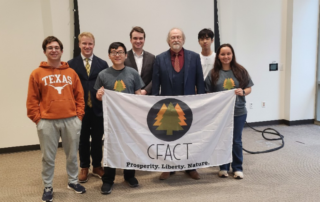
When CFACT Collegians Thien Nguyen and Tiffany Lomax set out to host energy expert Sterling Burnett on University of Texas Austin’s campus, they knew they were bringing students a perspective they rarely encounter in the classroom. The day began over lunch at a local Asian restaurant, where the CFACT Collegians sat down with Burnett and discussed the unique challenge of how to engage young people on complex energy issues. The conversation soon expanded into Burnett's work in energy policy, nonprofit advocacy, and the importance of educating the public on topics often overlooked in mainstream environmental discussions. Back on campus, students gathered [...]

CFACT Collegians Anna-Ramsey Watson of Clemson University and Taylor Elliott of Lipscomb University recently brought CFACT’s “Green Energy Kills” message to their fellow students with a creative twist: “Pin the Tail on the Energy Donkey.” The game challenged students to match the negative consequences of so-called “clean energy” with the energy sources responsible for them. Students were given slips of paper listing harmful effects connected to wind and solar power, then asked to “pin” each one to the correct energy source. The result was an interactive lesson in a truth rarely taught on campus: “green” does not mean clean. Taylor hosted [...]
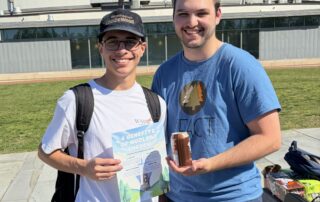
Under bright spring skies filled with aircraft taking off from the school-operated airport, and with a steady flow of prospective students visiting campus, CFACT Collegians at Liberty University turned a routine orientation day into a hands-on lesson in energy reality. On April 10th, campus representatives Silas Pearson and Colton Smith—joined by National Director Nate Myers fresh off CFACT’s ICCC16 conference in Washington, D.C.—hosted a dual event combining a nuclear soda giveaway with an interactive “Power the Grid” beanbag toss. The setup was simple, but the impact was anything but. Silas engaged students at the table, handing out sodas alongside flyers highlighting [...]
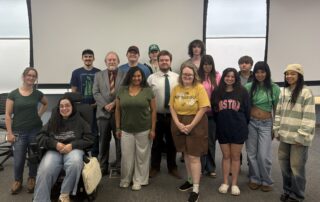
On St. Patrick’s Day at Sam Houston State University, CFACT Collegians Nicolas Walker and Nyle Torpy hosted a campus event that combined a lighthearted atmosphere with a serious conversation about energy and conservation. The turnout didn’t happen by accident. Nicolas and Nyle spent weeks promoting the event—handing out flyers, talking with students across campus, and building interest through word of mouth. By the time the day arrived, they had a solid group ready to show up, grab some food, and hear something different. And there was plenty of food to go around. Raising Cane’s chicken, pizza, and a spread of drinks [...]

For years, campus activists and administrators have tried to sell the public a fiction: college students are unanimously devoted to “green” energy mandates and climate alarmism, and anyone who questions the prevailing narrative is some kind of relic of the past. UT Austin student and CFACT Collegian intern Thien Nguyen decided to test that assumption the old-fashioned way—by asking students directly. Over the course of roughly a month, Thien conducted a seven-question survey alongside his three separate tabling events, handing out flyers with a QR code that took students straight to the online poll. Instead of relying on a single day’s [...]

Katie Pavlich joins District of Conservation again to dish Season 2 of her Fox Nation show and trending public policy issues.

In Episode 222 of District of Conservation, Gabriella discusses a breaking news story relating to the upcoming Virginia gubernatorial election and how the state's electric utility company funneled $200K to a shadowy leftist group discouraging gun voters from voting for Glenn Youngkin, who is more pro-gun than Terry McAuliffe.

At the same time the Greens want government to force us to use inefficient, intermittent wind and solar, and short-range electric vehicles, Green gadflies insist that we source none of the materials here. They block every mine and well, forcing producers to comply with Green mandates by sourcing the materials and products they demand overseas.

The catalyst for Chile's riots was a rise in Santiago Metro prices made necessary by carbon dioxide taxes and a conversion of the Metro from conventional power to renewable energy.

Germany was the first major economy to make a big shift in its energy mix toward low carbon sources, but Germany is failing to meet its climate goals of reducing harmful carbon-dioxide emissions even after spending over $580 billion by 2025 to overhaul its energy systems. Germany’s emissions miss should be a “wake-up” call for governments everywhere.
Concerns over impacts from energy projects disappear where “green” energy is involved.
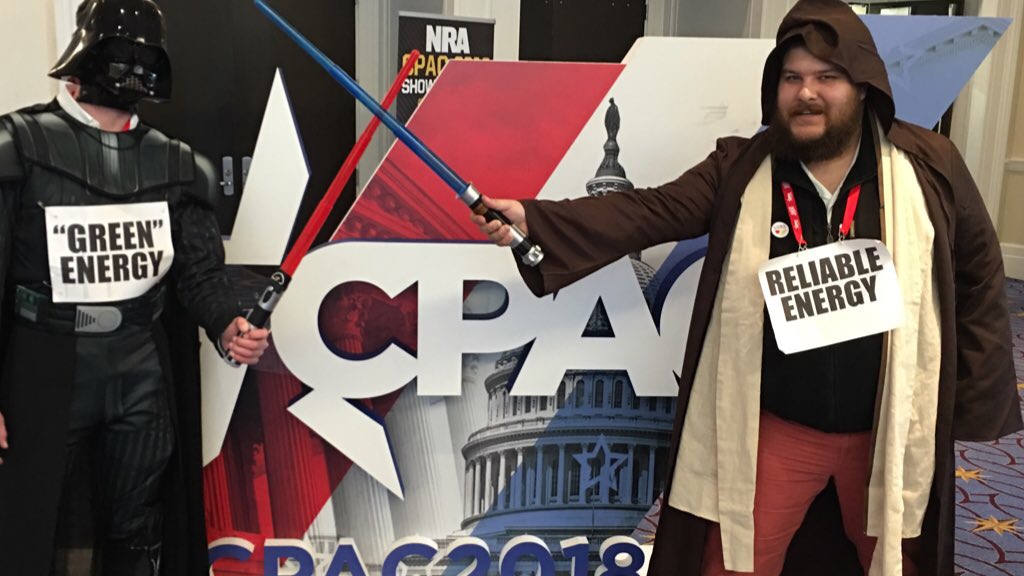
CFACT barnstormed CPAC, The Conservative Political Action Conference, this weekend with a series of activities that culminated in a light saber duel between “Green Energy” Darth Vader and the “Reliable Energy” Jedi!
New Zealander Bryan Leyland and Canadian Tom Harris, both of the International Climate Science Coalition, argue that the United States is setting a bad example and harming its own people -- and those in developing nations -- by continuing the EPA's war on coal, nuclear energy, and natural gas. Wind and solar have major problems with reliability, cost, and adverse health and environmental impacts that their proponents gloss over, whereas emissions from modern, highly efficient coal-fired power plants with stack gas cleanup consist almost entirely of water, CO2, and nitrogen.
West Virginia University professor James E. Smith and graduate student Alex Hatch report that the United States economy has begun to grow steadily despite falling oil consumption. Moreover, worldwide energy demand dropped significantly between 2013 and 2015 and the trend is continuing despite growing world populations and expanding energy availability. They note that , worldwide (not just in today's rich countries), the only thing limiting our future progress and comity is our imagination and ingenuity.